
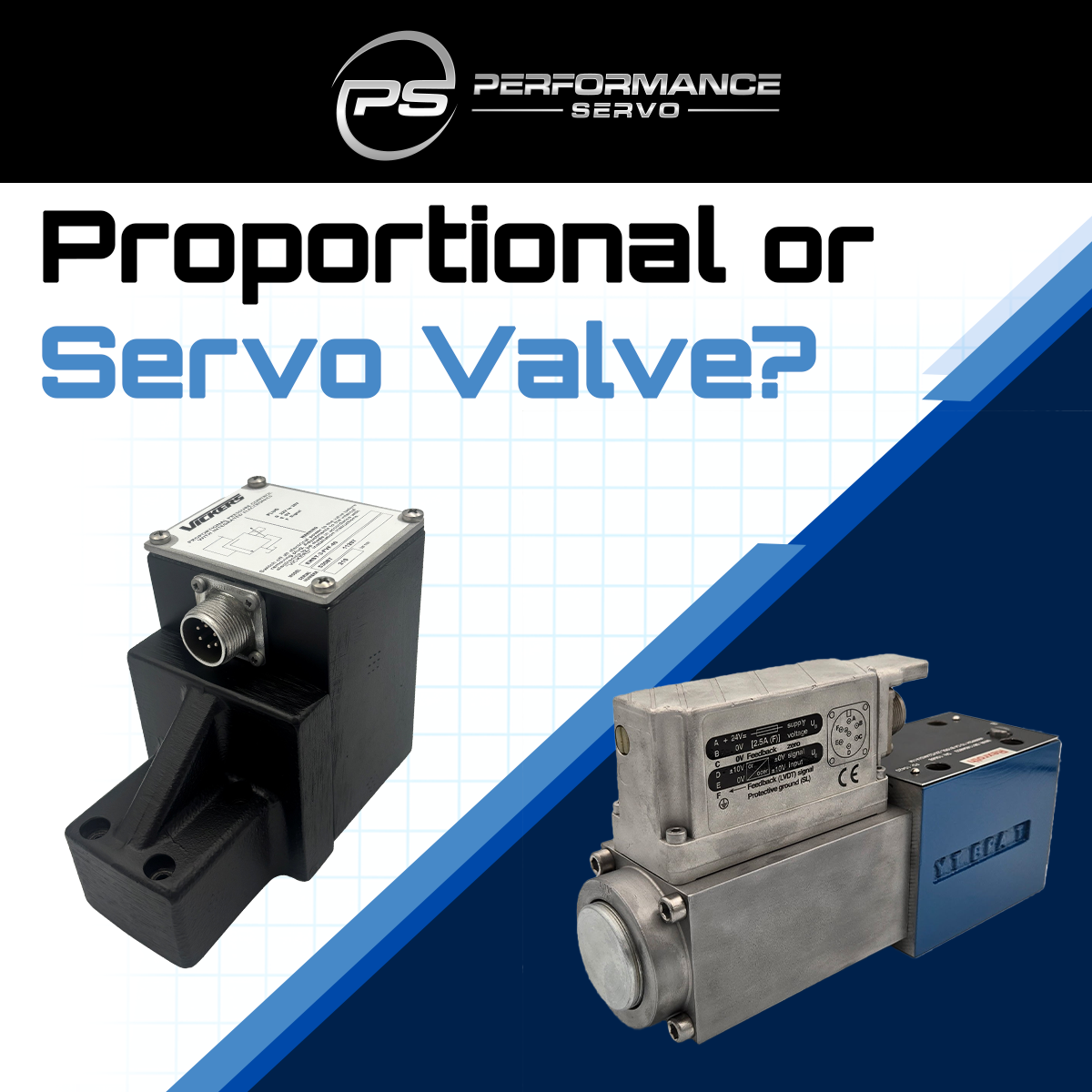
Your machine won’t hold a position. It’s drifting, hunting, or chattering under load. Someone on the floor says, “it’s the valve.” Fair enough.
But which valve? Proportional or servo?
Get that wrong and you order the wrong part, wait on the wrong lead time, or pay for precision your machine was never built to use.
This one comes up on almost every call we get. Let’s break it down plain, so you can look at what’s on your machine and know what you’re dealing with.
What a Proportional Valve Does
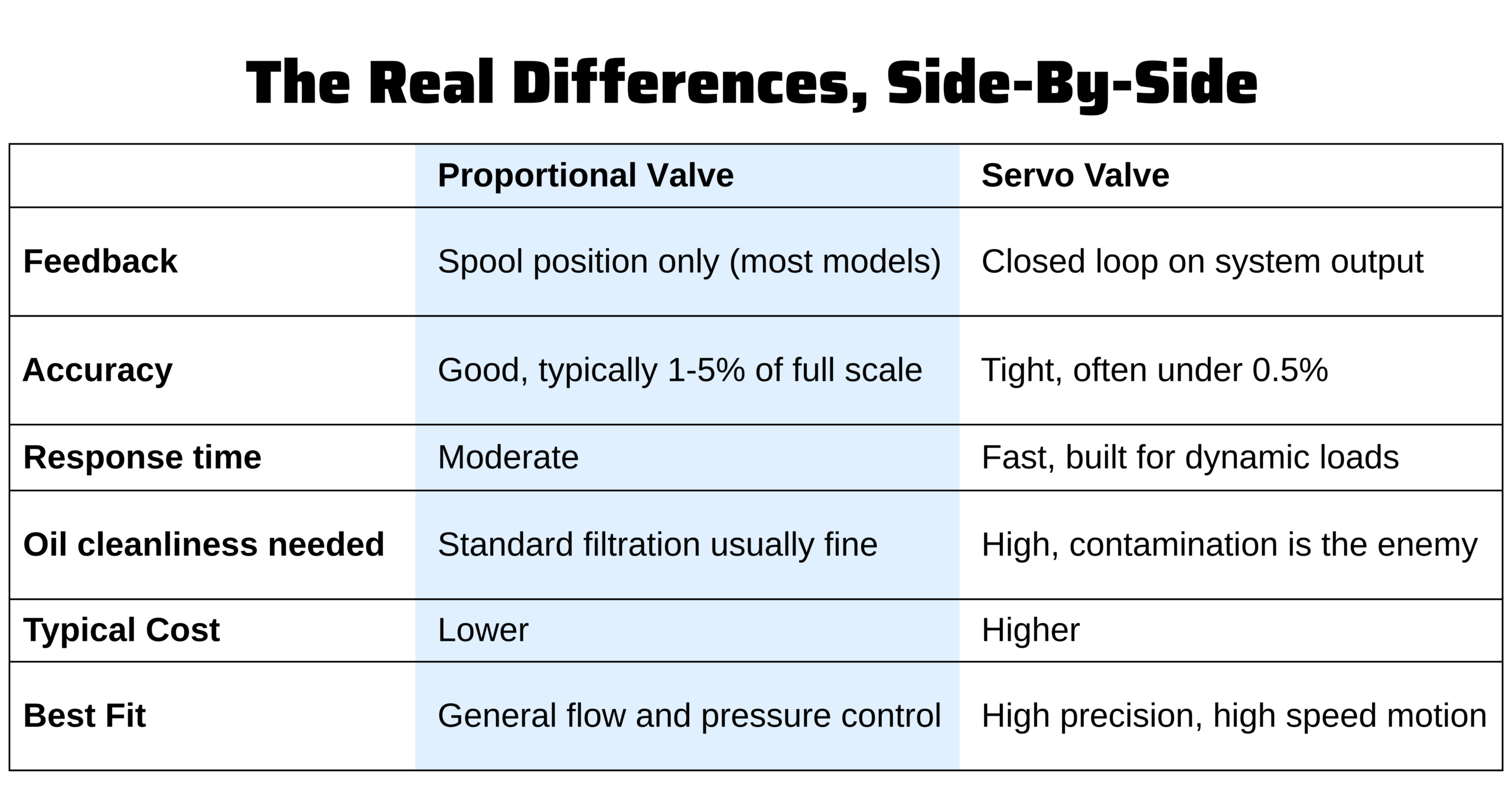
A proportional valve controls flow or pressure in steps that follow an electrical signal. Send it more current; you get more flow. Send it less; you get less. It’s a solenoid valve with a brain, built to respond in proportion to the input instead of just full-on or full-off.
Most proportional valves run open loop or with basic internal feedback from an LVDT or position sensor on the spool. That feedback keeps the spool where it’s supposed to be, but it’s not chasing the actual output of the system, like cylinder position or motor speed, in real time.
Where you’ll find them:
- Mobile equipment: lifts, cranes, ag and construction machinery
- Injection molding and press applications
- Any system where “close enough, fast enough” gets the job done
What a Servo Valve Does
A servo valve is built for tight, closed-loop control. It reads the actual output, position, pressure, velocity, whatever the system is measuring, and constantly corrects itself against that feedback. The control loop never really stops adjusting.
Servo valves respond faster and hold tighter tolerances than proportional valves. That precision comes from tighter internal clearances, torque motors instead of standard solenoids, and null-cut spools machined to a much finer standard. It also means they’re less forgiving of dirty oil and rougher duty cycles.
Where you’ll find them:
- Test stands and flight simulators
- Steel mills and metal forming lines
- CNC and precision motion control
Any process where a fraction of a percent of error is a scrapped part
What’s on Your Machine?
Not sure which one you’re pulling off the machine?
A few quick checks:
- Look at the actuator. A torque motor with a flapper-nozzle or jet-pipe stage usually means servo.
- Check the nameplate. Brands like Moog, Rexroth 4WS, and Vickers SM4/SX4 are servo lines. Rexroth 4WRPE, 4WRA, and Vickers KDG4V are proportional.
- Ask about the application. Fast, high-cycle, tight-tolerance work points to servo. General flow or pressure control points to proportional.
If you’re still not sure, send us photos and the nameplate info. We’ll tell you straight what you’ve got, no guessing.
Same Rules Apply to Electro-Hydraulic Pumps
The proportional vs. servo question doesn’t stop at the valve. Electro-hydraulic pumps pair a variable displacement piston pump with an integrated proportional or servo control valve on the swashplate. Same logic applies.
Proportional control gets you good response for most variable-flow applications. Servo control gets you tighter, faster control when the process demands it. Either way, the pump and the control valve get evaluated and rebuilt together, because they work as one system.
Why It Matters for Your Repair
Send us the wrong part number or misidentify what’s on your machine, and you risk downtime piling up while the right part gets sourced. We evaluate every valve and pump that comes through the door, confirm what it is, proportional or servo, and rebuild it to OEM spec. That includes upgraded electronics, a full clean and calibrate, and a burn-in test before it ships back.
Whether you’re a maintenance tech trying to get a line back up or a distributor stocking parts for your customers, the goal is the same: get you the right fix the first time.
Not sure if your valve is proportional or servo? Send it in. We’ll evaluate it, confirm what you’ve got, and quote the repair, no charge for the look. Call 866-SERVO-01 or e-mail sales@performanceservo.com.